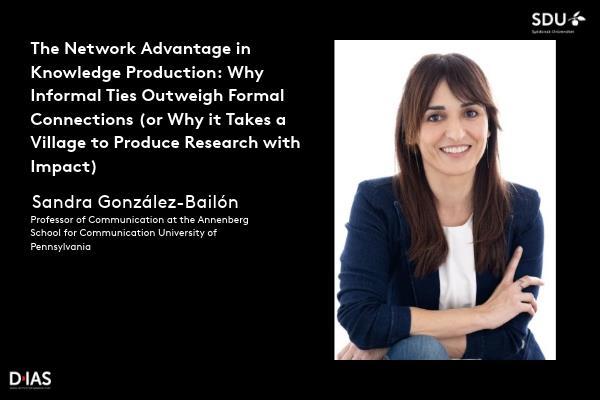
Social capital research helps us understand how relationships shape society. Relationships form networks that channel communication and shape who gets access to information, opportunities, and support. Academic performance relies on a special type of social capital known as the “invisible college”, a term that aims to capture the informal networks of scholars who exchange ideas, collaborate, and influence the direction of knowledge. Measuring this web of informal relationships is an empirical challenge. In this talk, I will discuss research in which we approximate these ties through the analysis of the ‘thank you’ notes appended to journal articles. Documenting how informal structures of support operate can help leverage collective resources in the pursuit of shared intellectual goals – and provide baselines to measure the impact AI will have on the social systems that sustain knowledge production.
About the speaker
Sandra González-Bailón is the Carolyn Marvin Professor of Communication at the Annenberg School for Communication at University of Pennsylvania, where she directs the Center for Information Networks and Democracy (CIND) and holds a secondary appointment in Sociology. Previously a Research Fellow at the Oxford Internet Institute (2008–2013), she earned her doctorate in Sociology from Nuffield College, University of Oxford, and completed her undergraduate studies at the University of Barcelona. Her research agenda lies at the intersection of computational social science, political communication, and the analysis of social and information networks.
- Organizer: Danish Institute for Advanced Study - DIAS
- Address: Campusvej 55, 5230 Odense M
- Add to your calendar: https://eom.sdu.dk:443/events/ical/14d93d6b-57fb-4681-b73b-27a389e76a6b