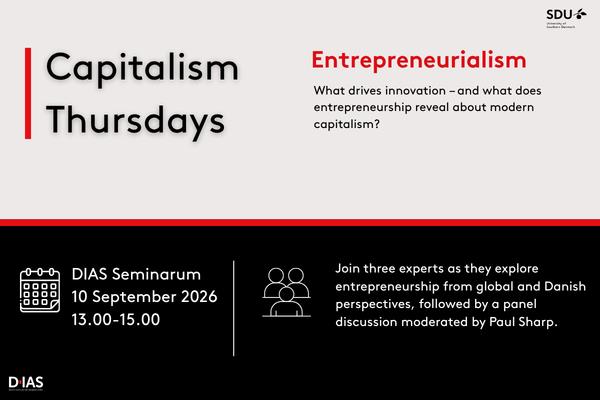
The event brings together three perspectives. Christina Lubinski will address entrepreneurialism as a concept, ideology, and historical phenomenon. Adam Frost will examine entrepreneurship and capitalism in China, drawing on his work on informal entrepreneurship and economic transformation in Maoist China. Mads Bruun Ingstrup will discuss Danish enterprise and cluster policy.
Each speaker will give a 30-minute presentation, followed by a 30-minute panel discussion moderated by Paul Sharp.
Programme
13:00–13:30 Christina Lubinski, CBS, Entrepreneurialism and the Futures of Capitalism: Ideology, Hype, and History
13:30–14:00 Adam Frost, DIAS/SDU, Entrepreneurial Co-Optation in Maoist China
14:00-14:10 Break14:10–14:40 Mads Bruun Ingstrup, SDU, Cluster policy as an instrument for growth and innovation
14:40–15:00 Panel discussion, moderated by Paul Sharp
Speakers
Christina Lubinski is Professor at Copenhagen Business School, where her work rethinks entrepreneurship in society by examining how entrepreneurial ideas and practices shape, and are shaped by, social, political, and cultural transformations.
Adam K. Frost is Assistant Professor at SDU and Fellow at DIAS. His research focuses on emerging market entrepreneurship and state-business relations, with a particular focus on China.
Mads Bruun Ingstrup is Associate Professor at SDU and Head of the Centre for Sustainable Business Development and Policy. His research focuses on clusters, firm networks, business ecosystems, regional development, and enterprise policy.
- Arrangør: Danish Institute for Advanced Study - DIAS
- Adresse: Fioniavej 34, 5230 Odense M
- Tilføj til din kalender: https://eom.sdu.dk:443/events/ical/5b6237b7-0cdc-4e2e-9119-046242eacd73